


The Foundation of a Safe Home: Understanding Licensed Roof Contractors
A licensed roof contractor is a professional who has met specific state or local requirements to legally perform roofing work. This credential is vital for protecting homeowners and ensuring quality.
Here’s why hiring a licensed roof contractor is crucial:
- Ensures Quality: They adhere to building codes and industry standards, preventing shoddy workmanship.
- Provides Protection: They carry essential insurance (like general liability and workers’ compensation) to cover accidents or damages, protecting you from financial liability.
- Offers Recourse: You have legal options and consumer protection if issues arise with their work.
- Stands Behind Work: Licensed contractors often provide warranties on their craftsmanship and materials.
- Avoids Scams: It helps you steer clear of unprofessional “storm chasers” or unqualified individuals.
Choosing a professional for your roof is a significant decision. Your roof protects your most valuable asset, and the right contractor ensures that protection lasts. This guide explains why licensing matters, how to verify credentials, and what to look for to ensure peace of mind.
As Jeffrey Goldman, my career has focused on what makes a professional reliable. My diverse background in fields from medical devices to personal fitness emphasizes the critical role of expertise and trust—principles that are paramount when choosing a licensed roof contractor. This understanding is key to safeguarding your investment and ensuring long-term quality.
What is a Licensed Roofing Contractor and Why is it Crucial?
A licensed roof contractor is a professional who has proven they meet specific state or local government standards. This means they’ve demonstrated competence, financial responsibility, and a commitment to quality work.
For homeowners in Southeast Michigan, this means a contractor has met criteria from the Michigan Department of Licensing and Regulatory Affairs (LARA) and often local rules too. It’s not just a piece of paper; it’s a commitment to accountability and quality.
This matters because a licensed contractor has been vetted. They’ve likely passed background checks, proven financial stability, and demonstrated their expertise. The process is designed to protect you, the homeowner, from headaches and financial risks.
A licensed roof contractor understands building codes, safety rules, and proper installation methods. This knowledge leads to a safer, more durable roof. Plus, if something unexpected happens, you have formal recourse, unlike with an unregistered individual who can simply vanish. This peace of mind is priceless.
Choosing a licensed roof contractor is the most important step for any roofing project. It ensures your roof is in capable and reliable hands. To dive deeper into this topic, take a look at our guide on Trusted Roofing Contractors: Key to Safe and Durable Roofing.
The Benefits of Hiring a Licensed Professional
The perks of working with a licensed roof contractor go beyond just following rules. These benefits directly impact the quality, longevity, and safety of your new roof, giving you invaluable peace of mind.
-
Insurance Coverage: A licensed contractor in Michigan must carry important insurance. This includes general liability insurance, which protects your property from damage during the work. They also need workers’ compensation, which covers their crew if someone gets hurt on your property. Without this coverage, you could be stuck paying for accidents.
-
Workmanship Warranty: Licensed pros usually back their work with a warranty. This means if there’s an issue with how the roof was installed, they’re responsible for fixing it. This is different from the manufacturer’s warranty, which covers faulty materials. In fact, many manufacturer warranties are only valid if a certified, licensed roof contractor installs the product. An unlicensed job could void your material warranty before it even begins.
-
Building Code Compliance: Licensed roof contractors know all local and state building codes. They understand the specific requirements for roofing in places like Macomb County, Oakland County, or Livingston County. This guarantees your roof is installed correctly, safely, and meets all standards for strength and insurance purposes. Cutting corners on codes can lead to big problems, denied insurance claims, and expensive fixes later.
-
Use of Quality Materials and Techniques: Reputable, licensed contractors often have strong connections with top material manufacturers. This gives them access to better quality products and training on the newest installation methods. For instance, EverNew Roofing’s certified professionals are experts at making asphalt shingles last longer. Whether you choose rejuvenation or a full replacement, you’re getting the best possible outcome.
Understanding your material choices is key, and a licensed professional can guide you. You can learn more about roofing materials and options here.
The Dangers of Hiring an Unlicensed Roofer
While a lower price from an unlicensed roofer might seem tempting, the risks are not worth it. Hiring an unlicensed contractor is a huge gamble with your home and savings.
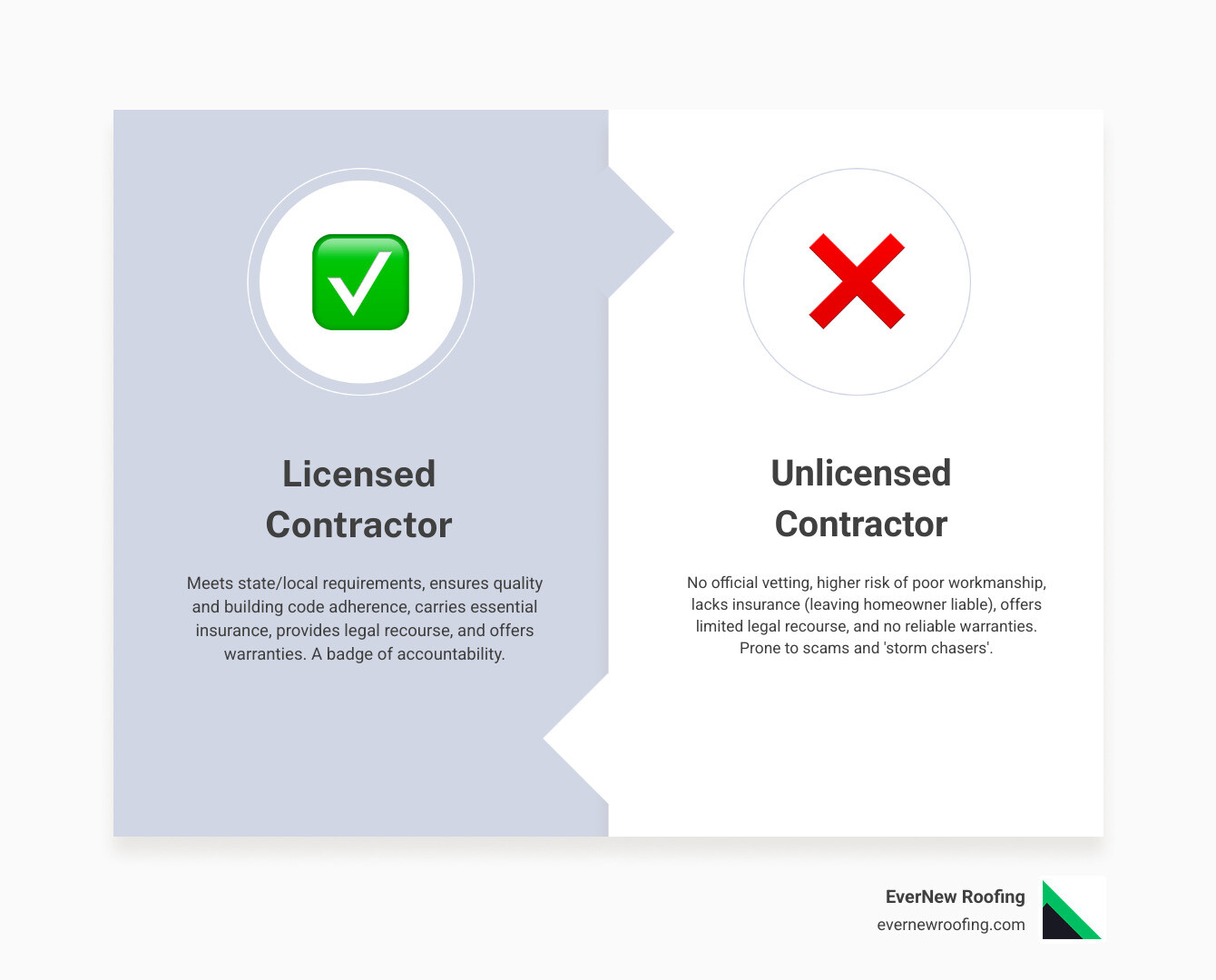
| Feature | Licensed Contractor | Unlicensed Contractor |
|---|---|---|
| Insurance | Required to carry General Liability & Workers’ Comp; protects homeowner from damages & injuries. | Likely uninsured; homeowner may be liable for property damage or worker injuries. |
| Warranty | Offers workmanship warranty; often provides access to valid manufacturer warranties. | No formal workmanship warranty; manufacturer warranties typically voided due to improper installation. |
| Legal Recourse | Clear legal channels for disputes; state/local licensing board oversight. | Limited to no legal recourse; difficult to track down or hold accountable. |
| Quality | Adheres to building codes & industry standards; often trained in best practices; higher quality outcome. | No oversight or adherence to standards; high risk of shoddy workmanship, shortcuts, and unsafe practices. |
| Accountability | Established business with reputation to protect; traceable via licensing boards. | Can disappear easily; difficult to verify background or experience; high risk of scams. |
Let’s look at some of the most serious dangers:
-
Financial Scams and Storm Chasers: After a storm, areas like Farmington Hills and Metro Detroit can attract “storm chasers.” These are often unlicensed individuals who offer quick, cheap fixes, take your money, and disappear, leaving you with shoddy work. A licensed roof contractor has an established local business and a reputation to protect.
-
Liability Risks: If an uninsured, unlicensed worker gets hurt on your property, you could be responsible for their medical bills and lost wages. If they damage your home or a neighbor’s property, you could be on the hook for those repair costs. Licensed roof contractors carry the right insurance to protect you from these situations.
-
Poor Workmanship: Unlicensed contractors usually lack the proper training, knowledge of building codes, or access to good materials. This can result in a roof that leaks, blows off in strong winds, or fails prematurely. These problems are expensive to fix and may require a complete re-roofing by a true professional.
-
Voided Warranties: As mentioned, many roofing material manufacturers require installation by a licensed and certified contractor for their warranties to be valid. If an unlicensed person installs your roof, your expensive materials might not be covered if they fail, leaving you with no protection.
An unlicensed contractor offers no promises, accountability, or protection. It’s a gamble that’s not worth taking with your home’s roof.
Your Due Diligence: How to Verify a Licensed Roof Contractor
Finding a licensed roof contractor in Southeast Michigan requires smart verification. This proactive process empowers you to protect your home and wallet.
Michigan’s main authority for contractor licensing is the Department of Licensing and Regulatory Affairs (LARA). However, local towns in areas like Washtenaw County or St. Clair County might have their own registration or permit requirements. Always check both state and local rules.
When evaluating contractors, go beyond the license number. Check their Better Business Bureau (BBB) ratings and read online reviews. Don’t be shy about asking for direct proof of their credentials. Vague answers, a refusal to show documents, or pushy sales tactics are all red flags. Trust your gut!

Step-by-Step Verification Process
Verifying a contractor can feel overwhelming, but we’ve broken it down into simple steps for homeowners across our service areas, from Lenawee County to Monroe County.
First, check the state database. Visit the Michigan Department of Licensing and Regulatory Affairs (LARA) website to search for a contractor by name or license number. Ensure their license is active and in good standing. In Michigan, roofers typically need a Residential Builders License or a Maintenance and Alteration Contractor (MAC) License.
Next, request current insurance certificates. Ask for proof of both general liability and workers’ compensation insurance. Ask to see the physical documents and consider calling the insurance company to verify the policy is active. This protects you from liability for accidents.
Then, read reviews and ask for references. Check independent review sites and local community groups. Ask the contractor for at least three recent references from projects similar to yours. If possible, drive by a few completed projects to see their work firsthand.
Finally, get multiple quotes. Obtain at least three detailed quotes from different licensed roof contractors. This helps you compare not just price, but also the scope of work, materials, and warranties. Be cautious of estimates that are significantly lower than others, as they may indicate shortcuts or hidden costs.
For more help finding trusted local professionals, you can Find trusted local roofers via the BBB.
Protecting Your Michigan Home from a Licensed Roof Contractor Scam
Even with a license, a little extra caution is wise. In Michigan, protecting your home from scams means knowing local rules and being firm about documentation.
Always verify the contractor’s license through the Michigan Department of Licensing and Regulatory Affairs (LARA). While Michigan doesn’t have a specific insurance minimum for roofers, a reputable licensed roof contractor will carry robust general liability and workers’ compensation insurance. Always ask for proof and verify it—it’s your safety net.
Most importantly, insist on a detailed written contract. This document should spell out the scope of work, materials, project timeline, payment schedule, and all warranty information. Read every line before you sign. A trustworthy contractor will gladly answer all your questions to ensure you understand every detail.
For more tips specific to our local communities, revisit our article, Don’t Get Nailed: Protecting Your Michigan Home from Roofing Rip-offs. Following these steps helps secure peace of mind for your home, whether it’s in West Bloomfield, Hartland, or anywhere in our service area.
Beyond the License: Understanding Additional Credentials and When to Call a Pro
While a licensed roof contractor is essential, some professionals take their commitment to quality further by earning extra credentials or certifications. These are often awarded by industry groups or material manufacturers and signify a deeper level of expertise and dedication.
These credentials often mean a contractor is committed to ongoing training, keeping them current on the newest materials and techniques. For you, this translates into superior product expertise, adherence to high installation standards, and improved warranties. Manufacturers trust these certified pros to install their products correctly, so they back them with better guarantees.
At EverNew Roofing, we believe in this commitment. Our certified professionals are always learning, which ensures we deliver the best roof rejuvenation and repair services. This gives you an extra layer of confidence. Learn more about our dedication to quality on our Why Choose Us page!
Key Signs You Need a Licensed Roof Contractor
Your roof works hard to protect your home from Michigan’s weather. It’s easy to forget about it until a problem appears. Knowing the signs of wear can help you call a licensed roof contractor before a small issue becomes a major, expensive headache.
Here are the key signs that it’s time to call a professional:
- Curling, Buckling, or Missing Shingles: If you notice asphalt shingles curling, buckling, or missing after a windy day, it’s a red flag. These shingles are no longer protecting your roof from leaks and damage.
- Granule Loss: Look in your gutters for dark, sand-like grit. These are granules from your asphalt shingles that protect them from UV rays. Once they’re gone, your roof’s lifespan drops quickly.
- Water Stains on Ceilings or Walls: Dark spots or streaks on your indoor surfaces mean your roof has a leak. Don’t ignore these, as leaks can lead to mold, rot, and serious structural damage.
- Roof Age: Most asphalt shingle roofs last around 20-25 years. If your roof is approaching or past this age, its protective power may be fading. A professional inspection can determine how much life it has left.
- Sagging Roof Deck: A sagging roofline is a serious structural concern. It can indicate problems with the underlying wood decking or support beams, often due to water damage. This requires immediate attention from a licensed roof contractor.
When these signs appear, a licensed professional can provide an honest assessment. They have the expertise to inspect your roof, pinpoint the problem, and suggest the best solution, whether it’s a repair, roof rejuvenation, or a full replacement. For more details, see our article on Key Signs You Need Roof Replacement Without Delay.
Frequently Asked Questions about Roofing Licenses
Navigating roofing licenses can be confusing. We’re here to answer some of the most common questions to help you make the best choice for your home.
What are the general requirements to become a licensed roofing contractor?
Becoming a licensed roof contractor is a rigorous process designed to ensure anyone working on your home has proven competence and reliability. While rules vary by state, common steps include:
- Experience and Training: Most states require hands-on experience. In Michigan, for example, applicants for a Residential Builders or Maintenance and Alteration Contractor license must complete 60 hours of pre-licensure courses.
- Exams: Applicants must pass exams covering trade knowledge as well as business and law.
- Background Checks: Many licensing boards run background and credit checks to ensure financial stability and integrity.
- Insurance and Bonding: Proof of general liability and workers’ compensation insurance is almost always required. Some states also require a surety bond, which acts as a financial safety net for consumers.
- Fees: Application and licensing fees typically range from $150 to $500.
This thorough process ensures a high standard for professionals, reflecting the ongoing need for skilled and licensed roofers in a growing industry. For more on this demand, you can check out the Projected growth in the roofing industry.
How do roofing license requirements vary by state?
Roofing license requirements vary significantly by state. Some states have a strong, statewide licensing system, while others let local cities or counties handle the details. A few states have no statewide roofing-specific license at all.
In Michigan, for example, roofers generally need a Residential Builders License or a Maintenance and Alteration Contractor (MAC) License from the Michigan Department of Licensing and Regulatory Affairs (LARA). Applicants must complete 60 hours of training and pass an exam. This means a licensed roof contractor in Macomb County or Oakland County has met a solid baseline of professionalism.
Even with state rules, homeowners should check with their local building department in places like Farmington Hills or West Bloomfield, as they may have extra registration or permitting requirements. Other states have different focuses: Florida emphasizes exams, Washington requires a $30,000 bond, and New Jersey demands $500,000 in liability insurance. Meanwhile, Texas has no statewide roofing license requirement.
What is the difference between a licensed and a credentialed roofing contractor?
Understanding this difference is key to making an informed decision.
A licensed roof contractor holds a government-issued license, which is a legal requirement to operate in a specific area like Michigan. This license confirms the contractor has met minimum standards for competency, building codes, and financial safeguards like insurance. It’s the baseline protection for homeowners.
A credentialed or certified roofing contractor has gone a step further. These are voluntary certifications from material manufacturers (like GAF or Owens Corning) or industry associations. Credentials show the contractor has received advanced, specialized training on specific products and installation techniques. This often results in higher-quality work and access to stronger, extended warranties from manufacturers who trust their expertise.
In short, a license is the legal minimum, while a credential demonstrates a higher standard of quality and specialized knowledge. While most certified roofers are also licensed, not all licensed roofers hold these extra certifications. At EverNew Roofing, our certified professionals meet Michigan’s licensing requirements and have the advanced training to deliver outstanding results.
Conclusion
Choosing the right professional for your roof—one of your home’s most critical defenses—is a major decision. This guide has explained why hiring a licensed roof contractor is essential for legal compliance, financial protection, peace of mind, and the long-term health of your home.
We’ve covered the fundamentals: what a license means, how it protects you from liability and shoddy work, and the dangers of hiring an unqualified roofer. You now know how to verify a license through Michigan’s LARA, what insurance to request, and which red flags to watch for.
Beyond legal minimums, certified and credentialed professionals show a deeper commitment to quality. They invest in ongoing training and often provide stronger warranty protection because manufacturers trust their expertise.
As a homeowner in Southeast Michigan, you have the power to protect yourself. By vetting contractors, asking the right questions, and insisting on proper documentation, you are making a smart investment in your home’s future and your family’s safety.
At EverNew Roofing, we understand that trust is earned. Our certified professionals are committed to transparency, quality, and extending the life of your asphalt shingle roof with innovative solutions like roof rejuvenation. We provide cost-effective options backed by expertise you can count on, including emergency and weekend service.
Don’t leave your roof to chance. Take control, do your homework, and choose a licensed roof contractor who stands behind their work with credentials and character.
Get an instant quote to fix your roof today and find how EverNew Roofing can help you protect your home for years to come.